
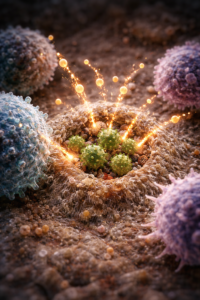
- Inflammation
- Secondly, another item
- Thirdly, a concise point
- Fourth, a bit more description
The Connection Between Chronic Inflammation and Chronic Disease
Chronic inflammation and chronic disease are deeply connected. While inflammation protects the body during injury or infection, it can quietly become harmful when it persists. Over time, low-grade immune activation disrupts tissues, damages cells, and contributes to long-term illness. Understanding this shift from protection to harm helps explain why so many chronic diseases share common biological pathways.
Inflammation is not inherently dangerous. In fact, it is essential for survival. However, when inflammatory signals remain active for months or years, they alter metabolism, weaken immune balance, and strain cellular repair systems. As a result, chronic inflammation becomes a central mechanism underlying many non-communicable diseases.
Below we explore how immune signaling, oxidative stress, mitochondrial dysfunction, and aging interact to drive chronic illness. We also explain scientific terms in clear language, helping readers understand what occurs inside the body during persistent inflammation.
Inflammation as a Central Mechanism
Inflammation is the body’s defense response to injury, infection, or cellular stress. During acute inflammation, immune cells release signaling proteins called cytokines, which coordinate healing and eliminate threats. This process typically resolves once the danger passes.
However, chronic inflammation behaves differently. Instead of shutting down, immune signaling continues at a low but persistent level. Scientists call this state “low-grade systemic inflammation” or, in aging, “inflammaging.”8
Several mechanisms maintain this prolonged activation. One involves damage-associated molecular patterns (DAMPs). DAMPs are fragments of damaged cells or cellular debris that the immune system recognizes as danger signals. When these fragments accumulate, they continuously stimulate immune receptors.
One key immune pathway activated during chronic inflammation is NF-κB (nuclear factor kappa-light-chain enhancer of activated B cells). NF-κB acts as a master switch inside immune cells. When activated, it enters the nucleus and turns on genes that produce inflammatory cytokines such as interleukin-6 (IL-6) and tumor necrosis factor-alpha (TNF-α). Persistent NF-κB activation has been documented in aging tissues and multiple chronic diseases.5
Another major component is the NLRP3 inflammasome. An inflammasome is a protein complex that senses cellular stress and triggers the release of powerful inflammatory cytokines, including IL-1β and IL-18. When overactivated, the NLRP3 inflammasome amplifies tissue damage and sustains inflammatory signaling.7
Importantly, chronic inflammation does not arise from infection alone. Aging cells can develop a senescence-associated secretory phenotype (SASP). Senescent cells no longer divide, but they release inflammatory cytokines and signaling molecules into surrounding tissues. This secretion pattern creates a pro-inflammatory environment that reinforces immune activation.
As immune activation persists, the body shifts from a balanced defense response to a self-perpetuating inflammatory cycle. Over time, this environment alters tissue structure, disrupts metabolic control, and increases vulnerability to chronic disease.
Oxidative Stress ↔ Inflammation Feedback Loop
Chronic inflammation rarely acts alone. It interacts closely with oxidative stress, creating a feedback loop that accelerates tissue injury.
Oxidative stress occurs when the production of reactive oxygen species (ROS) exceeds the body’s ability to neutralize them. ROS are highly reactive molecules generated during normal metabolism, particularly within mitochondria. At controlled levels, ROS serve important signaling functions. However, excess ROS damage proteins, lipids, and DNA.1
Inflammatory cells generate large amounts of ROS as part of their defense strategy. During acute infection, this burst of oxidative activity helps destroy pathogens. Yet when inflammation becomes chronic, sustained ROS production begins to injure healthy tissues.
This injury further activates inflammatory pathways. Damaged DNA and oxidized lipids act as additional DAMPs, stimulating NF-κB signaling and inflammasome activation. Consequently, oxidative stress fuels inflammation, and inflammation generates more oxidative stress.
The relationship becomes cyclical.
For example, studies of aging tissues demonstrate increased oxidative damage alongside elevated inflammatory cytokines. Similarly, cardiovascular disease, diabetes, neurodegeneration, and chronic kidney disease all show evidence of both redox imbalance and persistent immune activation.4
Additionally, oxidative stress impairs DNA repair systems. Accumulated DNA damage activates cellular stress responses, including further NF-κB activation. As repair capacity declines with age, this mechanism strengthens the link between oxidative stress and chronic inflammation.
In this way, oxidative stress does not merely accompany chronic inflammation. It reinforces and sustains it.
Mitochondrial Dysregulation & Immune Signaling
Mitochondria are often described as the “power plants” of the cell. They convert nutrients into energy through a process called oxidative phosphorylation. However, mitochondria also play a central role in immune regulation.
During normal metabolism, mitochondria produce small amounts of reactive oxygen species. These molecules act as signaling messengers. When mitochondria function properly, ROS levels remain balanced. Yet when mitochondrial function declines, ROS production increases dramatically.
Mitochondrial dysfunction has been identified as a core feature of chronic inflammation. Damaged mitochondria release mitochondrial DNA and other internal components into the cytoplasm. Because mitochondrial DNA resembles bacterial DNA, immune receptors interpret it as a danger signal.32
This misidentification activates pattern-recognition receptors and stimulates inflammasome pathways. In particular, mitochondrial stress strongly activates the NLRP3 inflammasome, amplifying IL-1β production and sustaining inflammation.7
Additionally, chronic inflammatory cytokines impair mitochondrial function. TNF-α and IL-6 alter metabolic signaling and disrupt energy production. Over time, cells shift from efficient energy generation toward altered metabolic states that favor inflammatory signaling.
This metabolic shift is sometimes described as “metabolic reprogramming.” Instead of prioritizing efficient energy production, immune cells adopt energy pathways that support rapid inflammatory responses. While useful in short-term defense, this shift becomes harmful when maintained long term.
Aging further intensifies this cycle. Autophagy and mitophagy — cellular processes that remove damaged mitochondria — decline with age. As a result, dysfunctional mitochondria accumulate, increasing ROS generation and inflammatory signaling.
Thus, mitochondria serve as both regulators and amplifiers of chronic inflammation. When their function deteriorates, the inflammatory feedback loop strengthens.
Chronic Inflammation Across Disease Types
One reason chronic inflammation attracts so much research attention is its presence across diverse diseases. Although these conditions affect different organs, they share overlapping inflammatory mechanisms.
In cardiovascular disease, chronic inflammation contributes to endothelial dysfunction and plaque formation. Inflammatory cytokines promote oxidative modification of lipids and damage to blood vessel walls. Over time, this process accelerates atherosclerosis.4
In metabolic disorders such as type 2 diabetes, low-grade inflammation interferes with insulin signaling. Adipose tissue releases inflammatory mediators that disrupt glucose regulation and promote insulin resistance.
Neurodegenerative diseases also show strong inflammatory signatures. Activated microglia — immune cells of the brain — release cytokines and ROS. When this activation becomes chronic, it contributes to neuronal injury and cognitive decline.
Similarly, chronic kidney disease, autoimmune disorders, and many cancers demonstrate persistent NF-κB signaling, inflammasome activation, and redox imbalance. While the initiating triggers differ, the downstream pathways often converge.4
Aging adds another layer to this pattern. Immunosenescence — the gradual decline of adaptive immune function — coexists with increased innate immune activation. This imbalance creates a pro-inflammatory environment sometimes described as inflammaging.6
Importantly, chronic inflammation does not mean visible swelling or acute symptoms. Instead, it often manifests as subtle, long-term immune activation measurable through biomarkers such as IL-6, C-reactive protein, and TNF-α. Recognizing these shared pathways helps explain why prevention strategies often target inflammation across multiple diseases rather than focusing on a single organ.
Lifestyle, Immune Regulation & Therapeutic Implications
Although chronic inflammation involves complex molecular pathways, lifestyle factors strongly influence its intensity.
Dietary patterns rich in refined sugars, processed foods, and excess calories can promote oxidative stress and inflammatory signaling. In contrast, diets emphasizing polyphenols, fiber, and omega-3 fatty acids support antioxidant defenses and modulate inflammatory pathways.
Physical activity also plays a regulatory role. Moderate exercise enhances mitochondrial efficiency and improves antioxidant capacity. While intense exercise temporarily increases inflammatory markers, consistent training improves long-term immune balance.
Psychological stress affects inflammation through hormonal signaling. Chronic stress elevates cortisol and sympathetic activation, which can alter immune regulation and promote inflammatory responses when persistent.
Caloric balance influences redox state as well. Research in animal models shows that caloric restriction improves antioxidant defenses and reduces inflammatory mediators. While extreme restriction is not advisable, metabolic balance appears central to inflammation control.
Therapeutic approaches increasingly target inflammatory pathways directly. Anti-inflammatory medications, antioxidant strategies, and metabolic interventions aim to interrupt the feedback loop between ROS and immune signaling. However, because inflammation also serves protective functions, complete suppression is neither possible nor desirable.
Instead, the goal is regulation rather than elimination.
By understanding how chronic inflammation and chronic disease intersect at immune, mitochondrial, and metabolic levels, individuals and clinicians can approach prevention more strategically. Early identification of inflammatory drivers may reduce long-term risk and improve overall health trajectory.
Final Reflection
Chronic inflammation and chronic disease are connected through shared biological mechanisms. Persistent immune signaling, oxidative stress, mitochondrial dysfunction, and aging create reinforcing cycles that alter tissue function over time. While the science is complex, the central idea is clear: when the body’s protective systems remain activated too long, they begin to cause harm. Understanding these pathways does not merely explain disease. It also opens the door to earlier intervention, targeted therapies, and informed lifestyle choices.
REFERENCES
- Mittal M, Siddiqui MR, Tran K, Reddy SP, Malik AB. Reactive oxygen species in inflammation and tissue injury. Antioxid Redox Signal. 2014;20(7):1126-1167. doi:10.1089/ars.2012.5149
- Patergnani S, Bouhamida E, Leo S, Pinton P, Rimessi A. Mitochondrial oxidative stress and “mito-inflammation”: actors in the diseases. Biomedicines. 2021;9(2):216. doi:10.3390/biomedicines9020216
- Hernández-Aguilera A, Rull A, Rodríguez-Gallego E, et al. Mitochondrial dysfunction: a basic mechanism in inflammation-related non-communicable diseases and therapeutic opportunities. Mediators Inflamm. 2013;2013:135698. doi:10.1155/2013/135698
- Rolo AP, Teodoro JS, Palmeira CM. Role of oxidative stress in the pathogenesis of nonalcoholic steatohepatitis. Free Radic Biol Med. 2012;52(1):59-69. doi:10.1016/j.freeradbiomed.2011.10.003
- Liu T, Zhang L, Joo D, Sun SC. NF-κB signaling in inflammation. Signal Transduction and Targeted Therapy. 2017.
- Montecino-Rodriguez E, Berent-Maoz B, Dorshkind K. Causes, consequences, and reversal of immune system aging. J Clin Invest. 2013;123(3):958-965. doi:10.1172/JCI64096
- Sebastian-Valverde M, Pasinetti GM. The NLRP3 inflammasome as a critical actor in the inflammaging process. Cells. 2020;9(6):1552. doi:10.3390/cells9061552
- Franceschi C, Garagnani P, Parini P, Giuliani C, Santoro A. Inflammaging: a new immune-metabolic viewpoint for age-related diseases. Nat Rev Endocrinol. 2018;14(10):576-590. doi:10.1038/s41574-018-0059-4